
Inside the Deeds Registries Act 47 of 1937
Most people think of property as the walls around them, the yard they cross or the roof that keeps the rain out. They think of homes, investments and the assurance that comes from knowing a place is theirs. Very few consider the legal system that makes ownership possible. Ownership has value only when there is a framework strong enough to prove it.
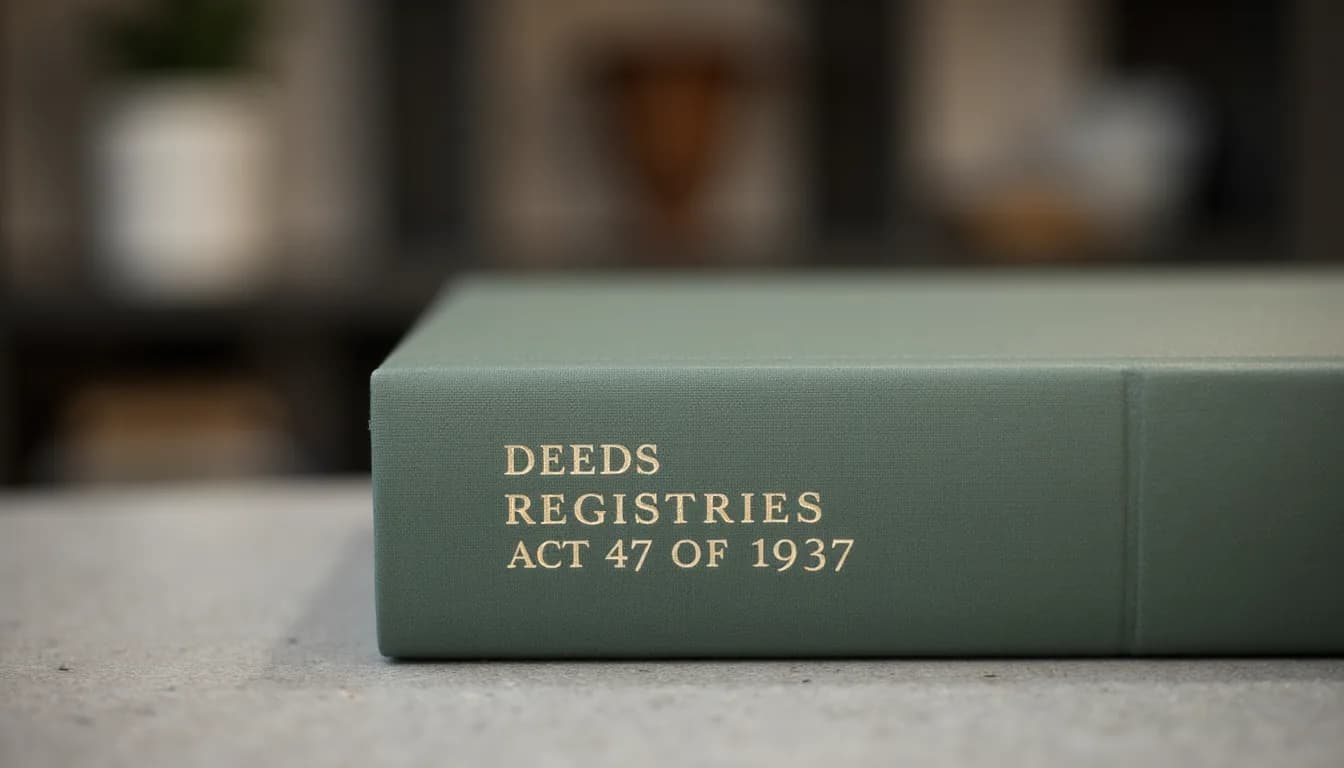
That framework is built on the Deeds Registries Act 47 of 1937, a statute that has shaped South Africa’s property landscape for generations. It carries no spectacle and makes no effort to draw attention. It stands quietly at the centre of the property system, maintaining the register with precision that does not falter. Without it, banks would not lend, buyers would not trust title deeds and transfers would carry unacceptable risk.
This is the law examiners apply every day. It is the law conveyancers must respect with every draft they prepare. It empowers the Registrar to change ownership with a single signature and gives the national register its authority. Conveyancing cannot be understood without this Act. It forms the spine of the system.
Every Signature Safeguarded. Every Transfer Secured.
The Architecture of the Registry

The Deeds Registries Act functions as the blueprint behind the national property register. It defines the structure of the Deeds Office, the duties of its officials, the format of documents and the systems governing land registration. Its purpose is to create a register that can be trusted without reservation and that protects the public from error and fraud.
Every property description, condition, servitude, mortgage bond and transfer must be recorded in strict alignment with the Act. Every deed must follow prescribed drafting conventions. Every examiner must apply the same rules. Without this structure, the property system would rest on instability. With it, the register stands firm.
Why Drafting Requirements Are Non-Negotiable
The Act dictates how property must be described, how title conditions are recorded and how deeds are structured. These are legal requirements, not stylistic preferences. They exist to ensure that each deed entering the system reflects the register accurately.
A conveyancer must:
- describe property using official survey data
- record real rights in prescribed form
- reference title conditions directly
- follow exact layout, spacing and terminology rules
- include all required endorsements
- align every clause with the existing record
This discipline exists to prevent ambiguity. A poorly drafted deed is not a minor inconvenience. It introduces risk into ownership records. The Act prevents that risk before the deed reaches the Registrar.
The Power and Purpose of Examination
Examination is not a cursory review. It is the legal process that protects the register from error.
Under the Deeds Registries Act:
- every deed passes through multiple levels of examination
- examiners compare the deed against the existing register
- inconsistencies must be corrected
- material defects result in rejection
- errors cannot be overlooked for convenience
An examiner is not an administrator. They serve as guardians of the register. Their authority to reject is protective. Rejection prevents a defect from becoming permanent. This is why conveyancers respect examiners. They are the final safeguard before execution.
The Registrar: Final Authority of Ownership
The Registrar of Deeds exercises authority that is both restrained and decisive. Under the Act, the Registrar may:
- register transfers and mortgage bonds
- cancel bonds
- endorse changes on title
- amend errors
- maintain the register
- refuse deeds that do not comply with law
When the Registrar signs, ownership changes immediately. Intention becomes legal fact. That signature is trusted because it operates within strict statutory limits. The Registrar cannot be rushed or influenced. Each deed may remain on record for decades. The Act ensures it enters correctly.
The Act and the Negative Registration System
The Deeds Registries Act operates alongside the negative registration system, which underpins South African property law. Under this system, the Deeds Office relies on the conveyancer’s certification rather than re-examining factual truth.
The Registrar checks alignment with the register and legislation. The conveyancer verifies the facts. This division allows efficiency without sacrificing reliability, but only because the Act enforces rigorous drafting and examination standards. The system does not tolerate assumption. It relies on structure.
How the Act Protects Real Rights
Real rights attach to property and pass from owner to owner. The Act governs how these rights are recorded, including:
- servitudes
- title conditions
- restrictions
- sectional rights
- mineral rights
- mortgage bonds
If these rights are recorded incorrectly, ownership becomes uncertain. The Act ensures they are reflected with precision, properly endorsed and never ignored during transfer. Buyers are protected from unexpected burdens. Sellers are protected by an accurate record. The register remains dependable because the law demands it.
The Deeds Registries Act governs how ownership is recorded, examined and confirmed, yet its role is often unseen by those involved in a transfer. The questions below address common points of uncertainty about how the register operates, why compliance is strict and how this legal framework protects ownership over time.
Frequently Asked Questions
Why is the Deeds Registries Act so strict about drafting?
Because every deed becomes part of the permanent national register, drafting carries consequences far beyond the immediate transaction. Once registered, a deed may remain on record for decades, relied upon by banks, purchasers, heirs and public institutions. A drafting error is not a minor oversight. It is a defect that can distort ownership, restrict rights or complicate future dealings with the property. Correcting such defects later is often complex, time-consuming and costly.
For this reason, the Deeds Registries Act treats drafting as a legal act rather than an administrative task. Each description, condition and endorsement must correspond exactly with the existing register and the underlying survey data. Precision is essential, not optional. By enforcing strict drafting standards, the Act ensures that the register reflects legal reality at the moment ownership changes. This discipline protects the public, secures lending practices and preserves confidence in the property system over time.
What happens if a deed does not comply with the Act?
The Deeds Office will reject a deed that does not meet the required legal standard. Rejection is not punitive. It is the mechanism through which the system prevents error from entering the national register. Once a deed is registered, it becomes permanent record. Any defect at that stage can affect ownership, real rights or title conditions for many years to come.
A faulty deed may introduce uncertainty around boundaries, restrictions, servitudes or authority. It may complicate future sales, delay financing or expose parties to dispute long after the original transaction has concluded. The Deeds Registries Act gives examiners the authority to intervene before this risk becomes embedded in the register. Their role is to protect the integrity of the record, not to accommodate convenience.
When a deed is rejected, the conveyancer must identify the defect, correct it in accordance with the Act and relodge the documents. This process ensures that only accurate, compliant deeds become part of the permanent register.
Why does the Registrar have so much power?
Because the Registrar’s signature changes ownership, it carries decisive legal consequence. Once signed, intention becomes fact and the register is altered with immediate effect. For this reason, the Deeds Registries Act grants the Registrar final authority over registration. That authority exists to ensure that each decision is legally sound, insulated from external influence and consistent with the existing register. The Registrar does not negotiate outcomes or accommodate urgency. The role is to apply the law as written.
Before a deed is signed, it must satisfy every statutory requirement. This includes correct drafting, proper examination, verified authority and full compliance with the Act. The Registrar relies on the work performed by conveyancers and examiners, but retains the final responsibility for allowing a deed to enter the register. By exercising this authority with restraint and discipline, the Registrar protects the integrity of the national property system. Ownership remains reliable because registration is controlled, deliberate and governed by law rather than circumstance.
Why Compliance Is Non Negotiable

The Registrar’s signature carries decisive legal consequence. Once signed, intention becomes fact and the national register is altered with immediate effect. The Deeds Registries Act grants the Registrar final authority over registration to ensure that every decision is legally sound, insulated from external influence and consistent with the existing register. Outcomes are not negotiated and urgency does not override compliance. The role is to apply the law as written.
Before a deed is signed, every statutory requirement must be satisfied. Drafting must be exact. Examination must be complete. Authority must be verified. Compliance must be beyond question. Through this disciplined process, the Registrar preserves the integrity of the national register and ensures that ownership remains reliable long after registration.
Every Signature Safeguarded. Every Transfer Secured.
Speak to a Conveyancing Attorney
If you are involved in a property transfer, the legal framework behind registration deserves careful attention from the outset. Engage a conveyancing attorney who understands the responsibility carried by every deed and every signature. Contact Wilma Ewest Incorporated to ensure your transfer proceeds on sound legal footing from start to registration.