
Compliance certificates required in a property transfer

The bond is approved and the conveyancer has sent through the instruction letter. Then a list arrives, longer than you expected: an electrical certificate, a gas certificate, a beetle inspection, possibly a plumbing certificate. Each one requires a separate specialist. Each one costs money. Each one can fail. If any single certificate isn't in the file when the conveyancer is ready to lodge, the transfer waits, regardless of what else is ready.
What are compliance certificates in a property transfer?
Compliance certificates are official written confirmations, issued by qualified inspectors, that specific installations or systems on a property meet the safety standards set by South African law. They form part of the seller's obligations in a transfer and must be provided to the transferring attorney before the transfer is lodged for registration.
Key Takeaways
- South African law requires certain compliance certificates before a property transfer can be registered, and the seller is responsible for obtaining them.
- The certificates most commonly required are the electrical certificate of compliance, the beetle inspection report, the gas compliance certificate, and, in some municipalities, a plumbing or water certificate.
- Each certificate is issued by a qualified inspector, carries a validity period, and must reflect the property as it stands at the time of issue, not a previous inspection.
- If an inspection fails, the seller must repair or rectify the defect and arrange a re-inspection. The sale doesn't fall away, but the transfer stalls until the certificate is clean.
- The offer to purchase usually determines who pays for each certificate. Where it is silent, the seller bears the cost as a default obligation.
- An expired or fraudulently obtained certificate exposes the seller to liability and leaves the buyer with a property that doesn't meet statutory standards.
The electrical certificate of compliance

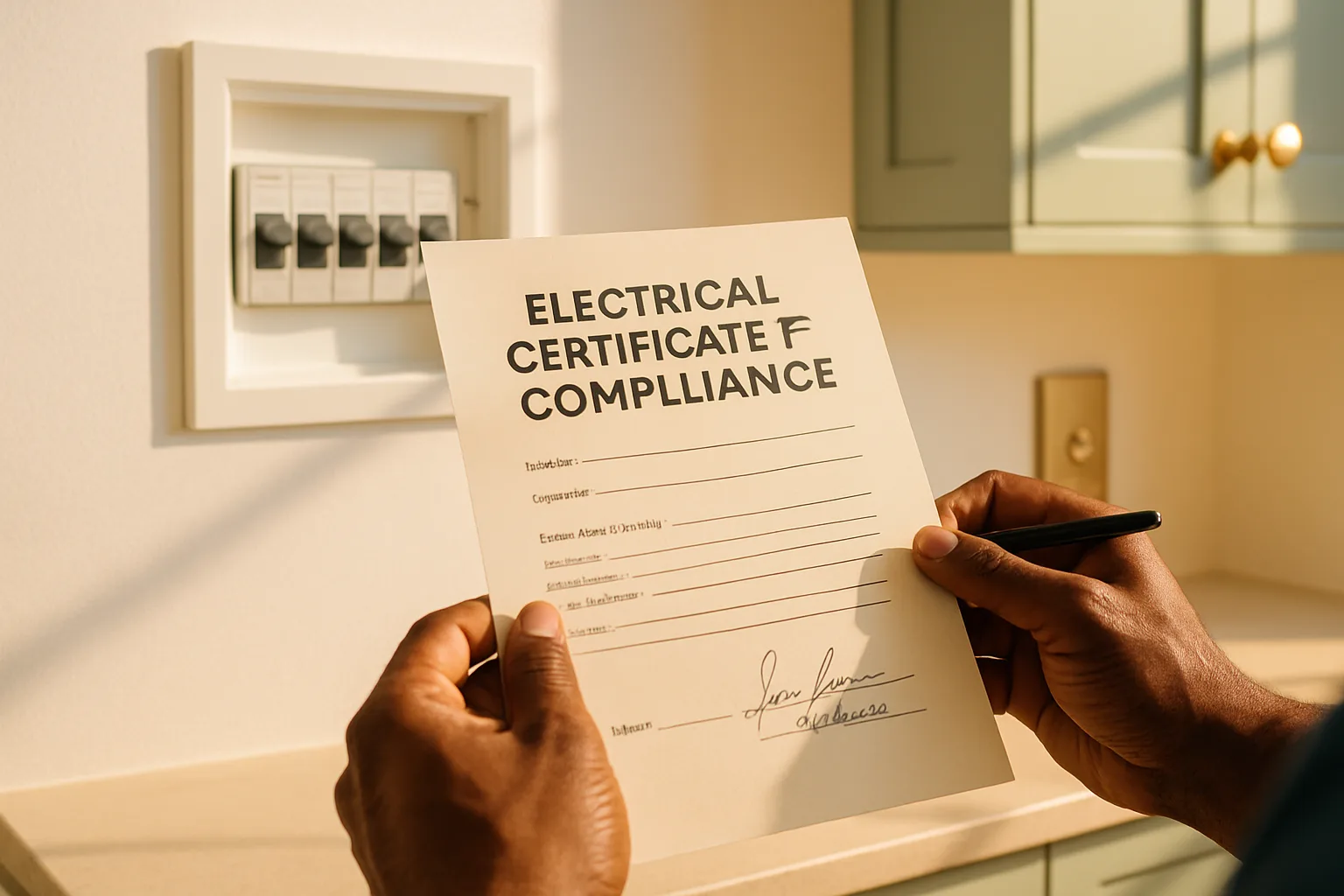
The electrical certificate of compliance appears in almost every residential transfer, and it's the one most likely to fail. It confirms that the electrical installation on the property, meaning the wiring, distribution board, earthing, and connections, complies with the Occupational Health and Safety Act and the South African national standard SANS 10142-1. Only a registered electrician who holds an installation electrician's licence issued by the Department of Employment and Labour may issue one.
The certificate covers the permanent installation. It doesn't cover portable appliances or light bulbs. What it does cover is the wiring behind your walls, the condition of the distribution board (the grey box where your circuit breakers live), the integrity of the earth connections, and whether the installation as a whole creates a risk of shock or fire. Inspectors check whether the installation matches the recorded layout and whether any additions since the last certificate, a garage conversion, a new geyser, an outdoor pool pump, were wired by a registered electrician and captured on the record.
A property with extensions built without proper electrical sign-off will fail the inspection. The seller then faces a repair bill before the transfer can move. In an older property in Edenvale or Germiston, where wiring hasn't been touched in twenty years, the bill for bringing an installation up to standard can run into tens of thousands of rands. Buyers rarely see that figure until it becomes a dispute about who bears it.
The law sets no fixed expiry date, but most offers to purchase require a certificate issued within the last two years, and it only holds if the installation hasn't been altered. If the existing certificate is still current and reflects the installation accurately, the seller doesn't need a new one, but the conveyancer will check it hasn't lapsed before lodgement.
The beetle inspection report
The beetle inspection report, sometimes called a wood-borer inspection or an entomological report, confirms the accessible wooden structures on the property are free of infestation by certain wood-destroying beetles. The report covers the roof timbers, flooring, and any other accessible structural timber. It doesn't cover furniture or stored timber.
The inspector looks for specific named species: borer beetles and related varieties whose larvae tunnel through timber and weaken structural members over years before the damage becomes visible. The inspection is most commonly required in coastal and highveld areas where humidity and vegetation create conditions for infestation.
Whether a beetle inspection is required in your transfer depends on the offer to purchase and, in some cases, on the geographic location of the property. Beetle clauses are standard in the Western Cape and common in KwaZulu-Natal; elsewhere, including Gauteng, they apply only if the offer to purchase includes one. The Western Cape has historically required beetle clearance because of the prevalence of certain species in the region's pine-heavy roof structures.
If the inspector finds active infestation or structural damage, the seller is responsible for fumigation and repair before a clear report can be issued. The cost of a standard inspection is relatively modest, often between R1 500 and R3 500, depending on the size of the property. Fumigation costs vary considerably based on the extent of infestation.
The gas compliance certificate
Any property with a fixed gas installation requires a gas compliance certificate before transfer. A fixed gas installation is a system connected to a permanent gas supply point: a built-in gas hob, a gas fireplace, an outdoor braai connected by a fixed pipe, or a gas geyser with a fixed feed. A portable gas cylinder on a camping-style hob doesn't trigger the requirement, because it's not a fixed installation.
The certificate confirms the installation complies with the Pressure Equipment Regulations under the Occupational Health and Safety Act. It must be issued by a registered person, meaning a gas installer registered with the South African Qualification and Certification Committee for Gas (SAQCC Gas).
Gas inspections fail most often where the seller has extended or modified an installation without using a registered installer, where flexible hose connections have aged beyond their safe service life, or where the gas appliance isn't properly ventilated. A kitchen renovation moving a gas hob and having the pipe reconnected by a general plumber rather than a registered gas installer is a common source of failure. The rectification isn't complicated, but it requires the right tradesperson and a re-inspection before a clear certificate can be issued.
Plumbing and water certificates
Some municipalities require a plumbing or water compliance certificate before a property can transfer. No national law requires one, so whether you need it depends on where the property is.
The City of Cape Town is the clearest example. Its Water By-law requires a Certificate of Compliance of the water installation, signed by a City-registered plumber, before any property in the city transfers, whether freehold or sectional title, and the buyer and seller can't agree to waive it. The plumber checks that the water meter registers, that no stormwater drains into the sewer, that drinking water isn't cross-connected to greywater, borehole or other water, and that the hot water cylinder meets the national standard. Johannesburg, Ekurhuleni and eThekwini don't currently require a municipal plumbing certificate on transfer, although a seller can still agree to provide one in the offer to purchase, and every transfer needs a rates clearance certificate.
| Municipality | Certificate | When required |
|---|---|---|
| City of Cape Town | Certificate of Compliance of the water installation (Water By-law), signed by a City-registered plumber | Every property transfer, freehold and sectional title; can't be waived |
| Johannesburg, Ekurhuleni, eThekwini | No municipal plumbing certificate on transfer; a rates clearance certificate is still required | Every property transfer |
The transferring attorney confirms which municipal requirements apply to your specific property early in the instruction process. If you're selling in an area where a plumbing certificate is required and neither the offer to purchase nor the attorney has flagged it, ask explicitly before the inspection schedule is set.
Who pays for compliance certificates
The offer to purchase decides. Most standard offer-to-purchase forms place the cost of compliance certificates on the seller, on the basis the seller must deliver a property meeting statutory standards, not simply hand over the keys. The seller arranges the inspection, pays for it, and handles any rectification required before a clean certificate can be issued.
The offer to purchase may allocate costs differently. A negotiated agreement might have the buyer accepting the property in its current condition and reimbursing the seller for inspection costs. Some offers are silent on specific certificates, which can create a dispute if a required certificate was never discussed. Where the offer is silent and the law requires the certificate, the seller still bears the obligation as the party responsible for delivery.
What the seller generally can't do is pass an uncertified property to the buyer and let the buyer arrange certification after registration. The certificate must be in the conveyancer's file before the transfer is lodged at the Deeds Office. That sequence is fixed by the conveyancer's obligations and by the requirements of the transfer process.
What happens when a certificate fails
A failed inspection doesn't cancel the sale. The suspensive conditions in the offer deal with conditions preventing a sale from coming into force; a compliance failure isn't one of those. The sale remains alive, the parties are bound, and the only question is when the certificate will clear and what it costs to get there.
The seller instructs the relevant tradesperson to rectify the defect. The electrician rewires the distribution board, the gas installer replaces the aged flexible hose, the fumigation company treats the roof timbers. Once the rectification is done, the inspector returns for a re-inspection and, if satisfied, issues the certificate.
The practical cost is time. A transfer ready to lodge in week eight waits until week ten or eleven if an inspection fails in week seven and rectification takes two weeks to schedule. During that gap, the buyer may be in occupation on an occupational rent arrangement, accumulating a daily charge. Where the seller has already committed to a purchase elsewhere and the proceeds of this sale are funding the next deposit, the delay ripples through a second transaction. The cost isn't always the repair bill; often it's the time lost.
What the conveyancer checks before lodgement
The conveyancing attorney doesn't simply collect the certificates and lodge them. Each one is read against the property description and the date of issue. An electrical certificate issued for a different property address, an inspection report predating a declared extension, or a gas certificate issued by someone not registered in the relevant trade are all failures at this check.
The conveyancer also confirms each certificate hasn't expired. Certificates issued for a previous potential sale that fell through and sat unused for two years may no longer be acceptable at lodgement if the offer requires a recent certificate or if the installation has been altered in the interim. A seller relying on a certificate from a previous attempted transfer without checking its current validity risks a late-stage failure at lodgement.
The Deeds Office doesn't examine the certificates in detail on lodgement day, but the conveyancer's professional responsibility requires what goes into the file to be accurate, current, and properly issued. An attorney who lodges with a defective certificate carries personal liability for the consequences, which is why the checks at the attorney's office are thorough before anything leaves for the Deeds Office.
The cost of getting this wrong
A seller who misrepresents a compliance certificate, or who presents one knowing the underlying installation doesn't comply, carries exposure lasting beyond registration. If the buyer discovers after transfer the electrical installation was defective at the time of the certificate, a claim for the cost of rectification is available. The seller who signed off on a certificate not reflecting reality is in a difficult position.
The buyer, for their part, shouldn't treat the certificates as a formality. Each one represents an independent professional's assessment of a specific system in the property. The electrical certificate confirms a registered electrician looked at the wiring and found it safe. The gas certificate confirms the installation won't leak. Reading the certificates before transfer, noting the inspector's registration number, and confirming the property described in the certificate matches the property you're buying is a straightforward precaution buyers frequently skip.
Responsibility after the transfer registers

The certificates required in a property transfer represent the floor of what safe property ownership requires, not the ceiling. Once you're the registered owner, maintaining those standards becomes your responsibility. The electrical installation certified on transfer day needs another certificate if you extend the house or alter the wiring. The gas installation cleared at inspection becomes your fixed installation to maintain. The compliance certificate file hands you a baseline from which your own obligations run.
You shouldn't have to guess which certificates apply to your property, who qualifies to issue them, or what happens when one fails. With Wilma Ewest Incorporated you won't.
Contact Wilma Ewest Incorporated to confirm which compliance certificates apply to your transfer and to make sure the file is complete before lodgement.
Compliance certificates raise more practical questions than most sellers anticipate and more than most buyers know to ask. The questions below cover what comes up most often.
Frequently Asked Questions
Who is responsible for obtaining compliance certificates in a property sale?
The seller is responsible for obtaining the required compliance certificates before transfer can be registered. This obligation exists because the seller is the party delivering the property, and delivery means delivering a property meeting statutory safety standards, not merely handing over the keys.
The cost of inspections and, where necessary, rectification falls on the seller unless the offer to purchase specifically allocates those costs differently. If the inspection fails, the seller arranges the repairs and the re-inspection. The conveyancer won't proceed to lodgement without a clean, current, and properly issued certificate in the file.
Buyers sometimes offer to accept the property and arrange certification themselves after transfer, as a negotiating tool in a tight market. Whether this is legally permissible depends on the applicable law and the specific certificate. For the electrical certificate of compliance, the obligation is statutory and can't simply be waived by agreement between the parties. For other certificates, the position may be more flexible, but the risk sits firmly with the buyer who accepts a property without confirmation it's safe. A conveyancer can advise on which certificates permit that kind of arrangement and which don't before any such agreement is signed.
How long are compliance certificates valid?
An electrical certificate of compliance is valid for two years from the date of issue, provided the installation hasn't been altered in the meantime. Any alteration to the electrical installation, including adding circuits, replacing the distribution board, or connecting a new fixed appliance, voids the existing certificate and requires a new inspection.
A gas compliance certificate has no fixed statutory expiry either; it holds as long as the installation hasn't been altered, although many offers to purchase ask for a recent one. A beetle inspection report is valid for three to six months, depending on the pest-control company's terms and the conditions of the offer to purchase. Some offers require a certificate issued within a specific period before the transfer date.
If a certificate expires between issue and lodgement, or if a new extension was built after the last certificate was issued, the conveyancer will flag this and ask for a new inspection. Using an expired certificate isn't a technicality to be argued around; it leaves both the conveyancer and the seller exposed. Sellers finalising a lengthy transfer should check the issue dates of all certificates against the expected lodgement date well before the file goes to the Deeds Office, so there's time to commission a fresh inspection if any have lapsed.
Can a property transfer proceed without all compliance certificates?
In most cases, no. The transferring attorney needs the full set of required certificates in the file before lodging the transfer at the Deeds Office. In practice, the conveyancer won't lodge until the certificates are in, so a missing certificate delays the transfer and adds costs.
There are limited exceptions. Where a specific certificate genuinely doesn't apply to the property, for example, a gas compliance certificate where no fixed gas installation exists, the conveyancer confirms that in the file rather than submitting a certificate. The conveyancer also records the position in writing where a municipality doesn't require a plumbing certificate for the relevant property type.
What doesn't work is a seller who simply hasn't obtained the certificate yet. The file waits until the certificate is in. The buyer's bond approval may have a registration deadline, the buyer may be paying occupational rent while the transfer is delayed, and the seller may have committed to a date elsewhere. The financial pressure falls on the party who caused the delay, which is usually the seller. Getting inspections booked early in the transfer process, rather than waiting until the conveyancer requests them, avoids most of these situations.
What does a compliance certificate inspection check?
Each inspection covers the specific system the certificate relates to. An electrical inspection checks the permanent wiring, distribution board, earthing, bonding of metalwork, and the condition of all fixed electrical connections. The inspector confirms everything visible and accessible meets the SANS 10142-1 standard.
A gas inspection checks the condition of the pipes, the connections, the appliances, the flexible hoses, the shutoff valves, and the ventilation arrangements. The inspector confirms the system is leak-free and the appliances are properly installed and matched to the gas supply.
A beetle inspection checks the accessible structural timber in the roof space, under-floor areas, and any exposed wooden structures. The inspector looks for active infestation, old infestation with live larvae, and structural damage caused by previous infestation. The report names what was found and what, if anything, needs treatment.
None of these inspections are general property condition assessments. They cover their specific system only. A property can have a clean electrical certificate and a leaking roof, a clear beetle report and rising damp. The certificates confirm each statutory system meets the required standard; they don't certify the property as a whole. Buyers who want a broader picture of the property's condition should commission a separate building inspection report alongside the statutory certificates.